Introduction:
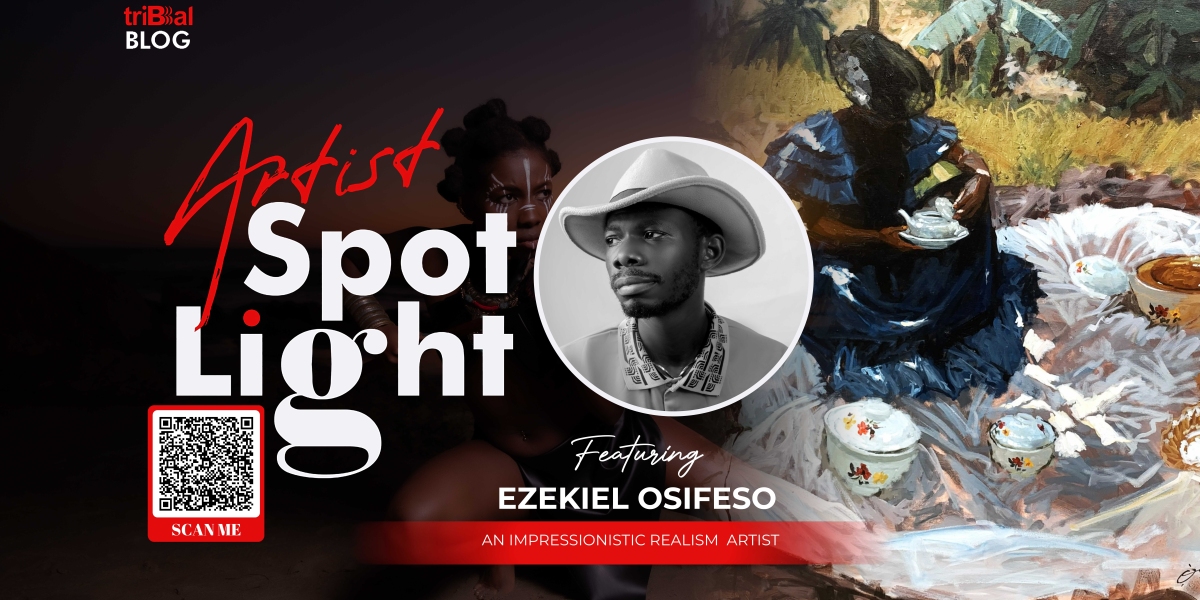
Ezekiel Osifeso's artistic journey is a compelling narrative of evolution, self-discovery, and a relentless pursuit of creative expression. His work, characterized by bold brushstrokes and a vibrant color palette, is a testament to his deep engagement with the world around him and his introspective exploration of the human condition. This article, based on an in-depth interview with the artist, traces the trajectory of his career, from his early inspirations to his current artistic philosophy, providing a comprehensive overview of his multifaceted and ever-evolving body of work.
Artists Bio:
Ezekiel Osifeso is an artist from Ogun State, born on August 15, 1992, in Lagos, Nigeria. He earned a degree in Visual Arts from the University of Lagos in 2013.
His early exposure to professional art practice began during his SIWES programme at Universal Studios, an experience that set him firmly on the path of artistic development. Building on this foundation, he returned to the studio for an extended internship from 2016 to 2018, where he trained under the tutelage of Mr. Abiodun Olaku, Mr. Joshua Nmesirionye, and Mr. Edosa Oguigo. Engagement with these distinguished art masters and the immersive studio environment significantly shaped his artistic philosophy and discipline.
Osifeso’s work explores life and its attendant socio-political realities. He has participated in several group exhibitions and has also presented a solo exhibition.
He currently lives and practices in Ibafo, Ogun State, Nigeria.
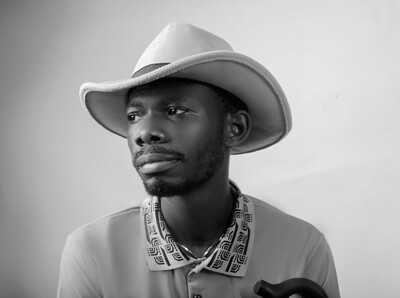
Q and A Segment with Ezekiel Osifeso
Q1. Could you share about your early life, and how your upbringing influenced your decision to pursue art?
My journey as an artist began with the influence of my parents. Although they were both teachers, they also had a natural ability to draw. I vividly remember, as a child, going to my father to helped me draw a picture of Jesus in our living room. My mother, in particular, was the one who insisted I would become an artist—long before I fully understood what that meant—simply because she saw how deeply I loved to draw. So I would say in many ways, I grew up knowing that art would be my path, guided by the clarity of purpose and encouragement my parents gave me.
Q2. How did your studies in Visual Arts shape your foundational artistic approach?
Studying Visual Arts was a great adventure; we were introduced to all aspect of the arts; Visual Arts, Theatre arts and Music. This seemed like a disadvantage at first but looking back, it helped build me as a complete artist understanding the importance of storytelling.
Moreso, I cannot tell my artistic journey without mentioning the role of Universal Studios of Arts where I did my 6-month SIWES programme. This was the time I built my foundation in drawing and painting. We had instructors like Mr Olaku, Mr Joshua Nmesirionye and Mr Ejoh Wallace. Those six months where pivotal in shaping the kind of artist I have become today.
Q3. Your career is marked by distinct phases. Can you elaborate on the transition from your early expressionist works to your later Fauvist and Impressionist-Realist styles?
I would say this journey began long before my professional practice. I recall a time when I helped my mother to deliver kunnu to one of her customers. In that compound lived an artist I would later come to know as Mr. Sam Ebohon. I was deeply drawn to his work. Though I couldn’t get too close, I watched him from a distance—this was during my secondary school years. In that moment, I knew I wanted to paint, to work with expressive strokes and vibrant colors.
When I gained admission into the University of Lagos, I met a painter named Onyike. He was in his 200 level while I was in my first year. His use of expressive brushstrokes immediately reawakened my long-standing love for expressive strokes. As a result, throughout my time in school, I gravitated naturally toward an expressionistic style of painting.
In 2013, I began studying closely under Mr. Sam Ebohon, and his influence became so strong that my work started to resemble his. This period marked a turning point, largely shaped by the guidance of my painting lecturer, Dr. Bolaji Ogunwo. He discouraged me from painting in Sam Ebohon’s style. At the time, it felt as though he was asking me to abandon something that was already working for me, but in retrospect, it was one of the most valuable pieces of advice I ever received.
Around this same period, I had been studying Fauvism and became deeply drawn to its use of bold, vibrant colours. This led me to begin painting in that direction—though in a more controlled and coordinated manner. It was also during this phase that I encountered the works of Mr. Edosa Oguigo, whom I would later meet in 2016.
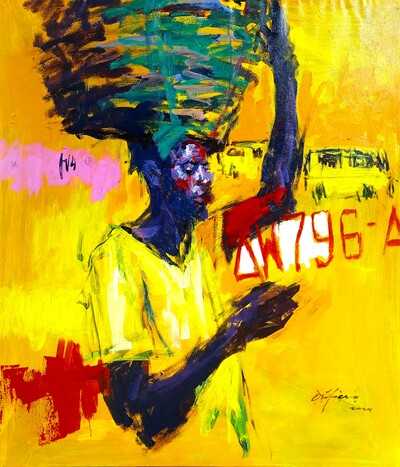
Title: Courrier Services
Click here to buy:
https://tribbbal.com/post/126501_courrier-services.html
At the height of this phase, I held a personal philosophy as a “fauvist” that deliberately avoided greys, browns, and earth tones. This choice made my work highly vibrant—sometimes even shouty. In 2016, while working as a graduate trainee at Universal Studios, Sam Ebohon visited and saw my recent paintings. He introduced me to the use of greys, explaining that they could help make my work feel more mature and inviting. I tried it immediately and was struck by the results.
From then on, I began experimenting with colours I had previously avoided, and my work gradually shifted toward realism. This transition also reconnected me to my long-standing admiration for Scott Burdick, whose impressionistic realism I had studied during my SIWES training in 2013. As my paintings continued to evolve in that direction, it slowly became clear to me that this was the style I had been moving toward all along—one that felt honest, balanced, and deeply personal.
Through this journey however, one thing remained constant: my bold brush strokes.
Q4. Your work often explores themes of rebirth, identity, constraint, and self-awareness. Which of these themes resonates most deeply with you personally, and why?
I would say all of them. As a deep thinker and highly introspective person, I’m drawn to titles that provoke thought and invite self- evaluation. It’s only through awareness—understanding who we are and why we are the way we are—that true self-evaluation becomes possible. From that awareness comes the ability to embrace correction, and ultimately, to experience rebirth. So in many ways, all of these themes are deeply interconnected.
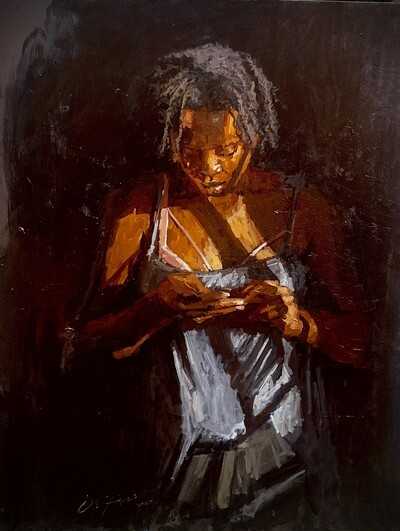 Title: Counting the Windows
Click here to buy:
https://tribbbal.com/post/126505_counting-the-windows.html
Q5. In what ways do you believe your art contributes to the broader conversation about the human condition and transformation?
I believe an artist functions much like a poet—or, at times, a musician. People are often drawn first to the beauty of a work, but many rarely pause to read between the lines and engage with the deeper message being communicated.
A clear example of this is my solo exhibition, The Streets Ain’t Smiling, particularly the clown series. One piece titled Side B speaks directly to a culture that celebrates the performer while overlooking the emotional weight and pain behind the performance. It reflects how audiences can enjoy the art yet miss the pain embedded within it.
This idea became especially poignant following the events surrounding Mohbad, where his pain was openly communicated through music, yet largely consumed as entertainment rather than a call for understanding. Through my work, I aim to surface these uncomfortable truths—using visual storytelling to invite viewers into deeper conversations about empathy, awareness, and transformation, with the hope that engagement leads to reflection and learning.
Q6. In "The Queen and Her Boxes," what are some of the invisible "boxes" you believe individuals construct around themselves, and how does the symbolism in the painting convey this?
In The Queen and Her Boxes, the invisible “boxes” represent the psychological and societal constraints individuals place upon themselves through their choices, fears, and need for acceptance. Every decision we make inevitably defines a boundary, meaning no one exists entirely outside of these boxes. The real conflict emerges when these boundaries are shaped by inferiority complexes, fear of rejection, or the pressure to conform. Many people choose to inhabit socially accepted “boxes” such as popular opinions and collective norms because they feel safer than the risk of forming independent ideologies. The symbolism in the painting reinforces this tension: the queen, adorned in royal regalia and posed with elegance and authority, paradoxically must bow or contort herself to fit within the boxes. This visual contradiction highlights how even those who appear powerful or self-assured can still be constrained by invisible expectations imposed by society and internalized by the self.
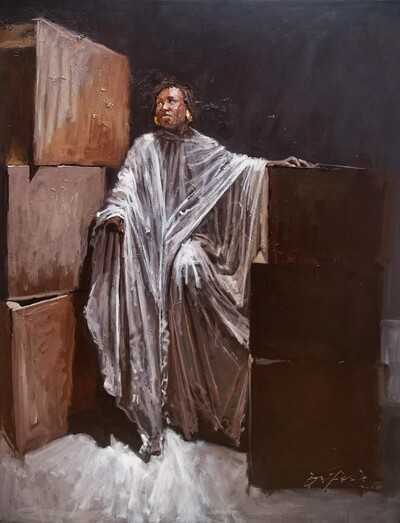 Title: The Queen and Her Boxes
Click here to buy:
https://tribbbal.com/post/126503_the-queen-and-her-boxes.html
Q7. What specific narratives of African youth are you exploring in Your series, "The Unfinished Business?
In The Unfinished Business, I explore the mindset of contemporary African youth shaped by speed, immediacy, and visibility. The series documents a fast-paced ideology where virality is often prioritized over longevity, and instant recognition can overshadow the patience required to build enduring legacies. While this cultural shift plays a role in societal evolution, the work questions the lack of balance it creates—highlighting the risk of constructing ambitious futures on shallow foundations that may ultimately collapse with time. Through this narrative, I invite reflection on sustainability, intention, and the unfinished work of building meaningful, lasting impact.
Q8. How do you envision the future evolution of your visual language, and are there any new techniques or themes you are eager to explore?
I can’t say with certainty how my visual language will evolve, as I see myself very much as a work in progress. My practice is constantly unfolding, shaped by time, experience, and curiosity. I’m currently developing several bodies of work, each exploring different directions and ideas, and I’m allowing them the space to evolve organically. Rather than forcing a destination, I’m interested in the journey—seeing what reveals itself along the way.
In many ways, the future of my work is still being written. Stay tuned.
Q9. What role do you believe contemporary African art plays on the global stage?
It’s changing the narrative and spotlighting Africa in the discourse of Arts globally. Now art platforms like triBBBal, galleries, international auction houses and magazines we read are now beginning to headline artists in Africa which is a big plus. I also think we need to be deliberate enough to exhibit the different schools of thought and ideologies in African Art on the global stage so that African Art would not be boxed into a particular identity.
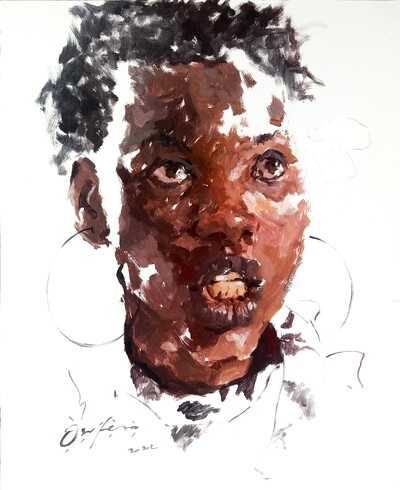 Title: Say Cheese
Click here to buy:
https://tribbbal.com/post/126502_say-cheese.html
Conclusion
Ezekiel Osifeso's artistic journey is a testament to the power of continuous learning, adaptation, and introspection. His work is a vibrant and thought-provoking exploration of the human experience, a mirror that reflects our own struggles, aspirations, and potential for transformation. As he continues to evolve as an artist, one thing is certain: his work will continue to captivate, challenge, and inspire audiences for years to come.
To learn more about Ezekiel Osifeso, please visit his profile:
https://tribbbal.com/OsifesoEzekiel